Out of Sight, Out of Budget: How Unreported Infrastructure Problems Vanish From City Maintenance Schedules
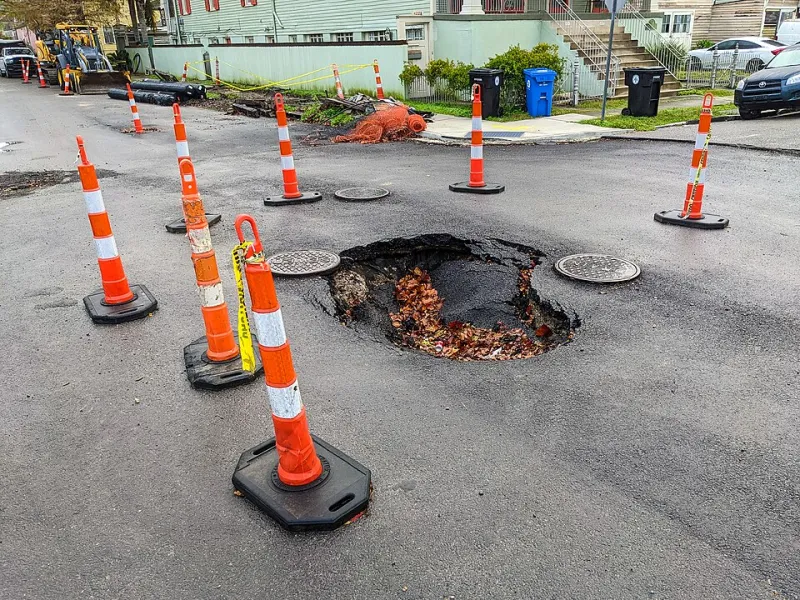
Photo: Bart Everson, CC BY 2.0, via Wikimedia Commons
There is a persistent and costly myth embedded in how many residents think about city government: the belief that someone, somewhere, is already keeping track of every pothole, every buckled sidewalk slab, every storm drain clogged with debris. It is a reasonable assumption. We pay taxes. We elect representatives. Surely the machinery of municipal maintenance is surveying our streets on a rolling basis, cataloging problems before they become emergencies.
It is not. Not entirely, and not equitably.
The uncomfortable truth is that most cities—including ours—operate infrastructure maintenance systems that are fundamentally reactive. Work orders are generated primarily by complaints, not by proactive inspection. And in neighborhoods where residents are less likely to file formal reports—whether because of language barriers, distrust of government, limited digital access, or simply the assumption that someone else already called—the streets quietly deteriorate while maintenance crews are dispatched elsewhere.
This office has spent considerable time examining how requests move through the system, where they stall, and which communities bear the burden of institutional inattention. What follows is an honest account of what we found—and a practical framework for ensuring your concerns are never quietly discarded.
How the Maintenance Pipeline Actually Works
When a resident submits a complaint—through a 311 call, a mobile app, an online portal, or a direct communication to this office—that report enters a queue managed by the relevant city department. Public Works, Transportation, or Streets and Sanitation, depending on the nature of the issue, will assign the request a service number, categorize it by type and severity, and place it within a prioritization matrix.
That matrix is where politics and bureaucracy intersect in ways that are rarely visible to the public.
High-volume complaint categories—potholes on arterial roads, downed trees blocking traffic—tend to move quickly because the sheer number of duplicate reports signals urgency to supervisors. A single pothole reported by forty drivers on a busy commuter corridor will almost always be addressed before a similarly sized pothole on a residential side street reported by one person, or by no one at all.
The system, in other words, rewards density of complaints. And complaint density is not evenly distributed.
Which Neighborhoods Get Left Behind—And Why
Data compiled from service request records across comparable wards consistently reveals the same pattern: lower-income neighborhoods and communities with large non-English-speaking populations generate significantly fewer formal infrastructure complaints per capita than higher-income, predominantly English-speaking neighborhoods—even when physical conditions are objectively worse.
City staff interviewed for this piece were candid about the implications. One department supervisor put it plainly: "If we don't get a ticket, we don't have a job number. If we don't have a job number, it doesn't exist in the system. It doesn't get scheduled, it doesn't get budgeted, and when we're doing year-end reporting, it looks like that block had no needs."
That last point is particularly consequential. Annual maintenance reports, which inform the following year's budget allocations, are largely built from completed service requests. A neighborhood that underreports problems appears, on paper, to have fewer infrastructure needs. It therefore receives fewer resources. The gap widens. The cycle repeats.
This is not an accident of bureaucratic indifference alone. It is a structural flaw that progressive governance must actively work to correct—through proactive inspection programs, multilingual outreach, and aldermanic advocacy that pushes back against data that systematically undercounts need.
The Types of Complaints That Get Shelved
Not all requests are treated equally even when they do enter the system. Based on departmental priority frameworks, certain categories of complaints are routinely deferred:
Cosmetic or non-safety-rated defects. Cracked but technically passable sidewalks, faded crosswalk markings, and minor drainage issues that do not yet cause flooding are frequently logged and postponed indefinitely. Without follow-up, they remain in a perpetual holding pattern.
Single-source complaints. A problem reported once, by one person, with no duplicates, is statistically far less likely to be addressed within a standard service window than the same problem reported multiple times.
Issues without clear departmental ownership. Infrastructure problems that fall at jurisdictional boundaries—between city and county responsibility, or between two city departments—often get bounced between agencies, generating paperwork but no actual repair.
Verbal or informal complaints. Concerns raised at community meetings, mentioned to a ward clerk, or communicated through social media without a formal service request number attached are effectively invisible to the maintenance scheduling system.
What This Office Is Doing About It
Alderman Moreno's office has been working on multiple fronts to address these structural gaps. We have pushed for expanded proactive inspection schedules in historically underserved parts of the ward, advocated for multilingual access to the 311 reporting system, and maintained direct relationships with department liaisons who can flag stuck requests and escalate stalled tickets.
We also track open service requests submitted through this office to ensure they receive documented follow-up—something that does not happen automatically when a resident submits a complaint independently.
But institutional advocacy, while necessary, is not sufficient on its own. The most durable protection against your block being overlooked is an informed, engaged constituency that knows how to use the system effectively.
Your Checklist for Getting Infrastructure Issues Documented and Tracked
The following steps represent the most reliable path from a problem on your block to a completed repair:
-
Submit a formal 311 request. Use the city's official 311 service—by phone, app, or web portal—rather than relying on informal channels. This generates a service request number, which is your proof of entry into the system.
-
Record your confirmation number and the date of submission. Without this, you have no leverage for follow-up.
-
Photograph the problem with a timestamp. Documentation strengthens your case if the request is disputed or deprioritized.
-
Follow up at 10 days. If you have not received a status update within ten business days, contact 311 again and reference your original service number. Escalate to this office if you receive no substantive response.
-
Recruit neighbors to submit duplicate reports. Multiple complaints about the same issue dramatically increase the likelihood of prompt action. Share your service request details with neighbors and encourage them to file independently.
-
Contact this office directly for chronic or safety-critical issues. Our team can intervene with the relevant department, flag requests for expedited review, and document patterns that may warrant a broader policy response.
-
Attend ward meetings and speak on record. Public testimony creates an additional paper trail and signals community attention that department heads cannot easily ignore.
The Broader Principle
Infrastructure maintenance should not function as a system that rewards residents who are already well-positioned to navigate bureaucracy. Our ward deserves equitable attention regardless of whether every household has broadband access, fluency in English, or the time to follow up on a service ticket twice a week.
This office is committed to building the kind of ward-level accountability that closes those gaps. But we need residents as partners in that effort. The streets that go unreported are the streets that get forgotten—and it is within your power to make sure yours is never one of them.
If you have a persistent infrastructure issue that has not been resolved, or if you are unsure how to navigate the reporting process, contact Alderman Moreno's office directly. We are here to help you cut through the system—and to fight for the structural changes that will make that system fairer for everyone.